

최신 연구
[백록현 교수] Physics-Assisted Neural Network Modeling of Advanced Recessed-3D NAND Cells Under Sparse-Data Conditions
- 등록일2026.06.01
- 조회수13
-

교수백록현
[연구자명]
- 조경래, 김수민, 엄승준, 강신영, 정성수, 백록현(지도교수)
[연구제목]
- Physics-Assisted Neural Network Modeling of Advanced Recessed-3D NAND Cells Under Sparse-Data Conditions
- [연구내용 요약]
본 연구는 sparse-data 조건에서 advanced recessed 3-D NAND cell의 threshold voltage 특성을 예측하기 위한 electric field-assisted neural network (EFA-NN) 모델링 프레임워크를 제안하였음. Convex/concave recessed 3-D NAND 구조는 program 및 retention 특성을 개선할 가능성이 있지만, 3-D TCAD 시뮬레이션 비용이 높아 충분한 학습 데이터를 확보하기 어려움. 이를 해결하기 위해 본 연구는 단순 구조 파라미터만 사용하는 기존 MLP 대신, ISPP 및 retention 동작 중 변화하는 electric field evolution을 physics-aware key feature로 활용하였음. 또한 conventional cell의 dense dataset에서 학습한 정보를 advanced recessed cell의 sparse dataset으로 transfer learning하여 예측 정확도를 향상시켰음. 제안된 EFA-NN은 sparse 조건에서 기존 MLP 대비 최대 약 35% 높은 정확도를 보였고, NSGA-II 기반 multi objective optimization과 결합하여 program window degradation 없이 retention 특성을 약 34% 개선한 concave recessed 구조를 도출하였음.
[성과와 관련된 이미지 및 설명]
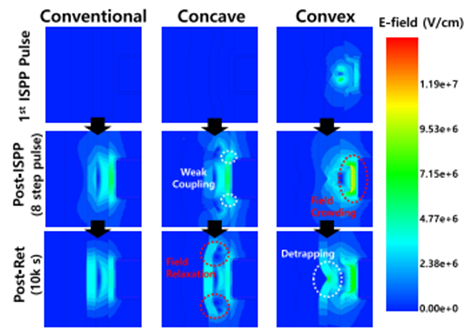
그림1 설명. Convex 구조가 gate-side electric field crowding으로 program 효율은 증가하지만 retention 중 detrapping이 커지는 반면, concave 구조는 electric field가 더 완만하게 분포되어 retention loss를 줄일 수 있음
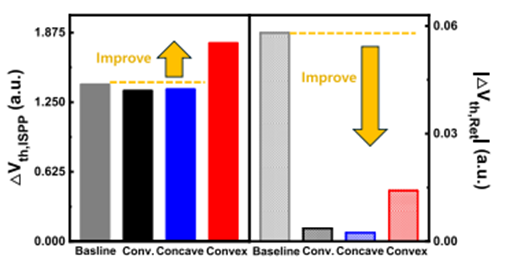
- 그림2 설명. 최적화된 concave recessed cell이 optimized conventional cell 대비 ISPP-induced Vth shift는 유지하면서 retention-induced Vth loss를 약 34% 줄여, 기존 program–retention trade-off를 완화함을 확인하였음.
[연구결과의 진행 상태 및 향후 계획]
- EFA-NN 기반 sparse-data 예측 프레임워크를 다양한 recessed geometry 및 공정 변동 조건으로 확장하고, TCAD–AI–최적화 연계 설계를 통해 program/retention/reliability 특성을 동시에 개선할 수 있는 3-D NAND cell 설계 가이드라인을 도출할 계획임.
[성과]
“IEEE Transactions on Electron Devices” 출판